Cats and Mirrors: The Truth Behind Curious Gazes
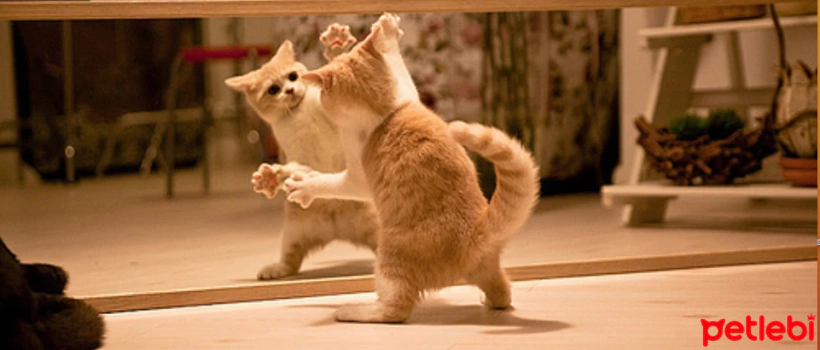
Self-awareness in the animal world remains a fascinating topic, as it is considered a sign of intelligence and has long been researched by scientists. The different reactions cats give when they see themselves in the mirror also captivate the curiosity of cat owners.
Advertisement
Self-awareness in the animal world remains a fascinating topic, as it is considered a sign of intelligence and has long been researched by scientists. The different reactions cats give when they see themselves in the mirror also captivate the curiosity of cat owners. Although cats may exhibit distinct reactions when they notice their reflections in the mirror, experts state that cats do not recognize themselves, but rather perceive their own reflections as a potential rival. Of course, these statements should not be interpreted as meaning that cats have such low intelligence that they cannot recognize themselves. For living beings to be able to perceive their reflection in a mirror, they need to consciously perform movements, track their actions, and make sense of the image that appears in the mirror. Naturally, the convergence of all these conditions is a very complex process. Indeed, the same situation, namely the inability to associate their reflections in the mirror with themselves, is observed in babies during the first year of life.

Cats' First Encounters with Mirrors: What Are Their First Reactions?
A study published in Popular Science states that cats cannot recognize themselves. Although cats continue to react to the image in the mirror, it does not seem possible to say that they are acting with the awareness that the reflection they are reacting to is their own reflection. So, how does your cat react when it sees itself in the mirror during that first encounter?
When cats see their reflections in the mirror, they do not recognize themselves and usually think that the reflection they see is a potential rival or enemy. Moreover, some cats may find it disturbing that the reflection they see matches their own movements, smells, and behaviors. Consequently, their reactions vary. Some cats may exhibit aggressive behavior, thinking they are facing a formidable opponent that perfectly mirrors their own reactions. A cat looking in a mirror may hiss, puff up its tail, scratch the mirror, and pull its ears back, showing signs of aggression when it perceives the reflection as a rival. Some cats, however, may approach reflections with more curiosity and search for what they see behind the mirror. A cat looking in a mirror may not react at all, or may even ignore the image and leave the area. Considering all this, it would be most accurate to say that not all cats react the same way when looking in a mirror, but there are certain common behavioral patterns associated with mirror looking in cats.

Do Cats Fear Mirrors?
A cat looking in a mirror may suddenly run away or attack the mirror. The underlying reason for these two behaviors is their fear of their reflection in the mirror and the feeling of vulnerability they experience. Taking precautions is crucial for cats who are afraid of looking in the mirror. Cats that flinch and become frightened when looking in the mirror may experience a significant increase in heart rate. Unfortunately, for some cats, this can be life-threatening. Therefore, it is recommended to take steps to help cats overcome their fear of their own reflection or to eliminate the sources of their fear.

What Can You Do to Prevent Your Cat from Being Afraid of Mirrors?
Different techniques can be applied to prevent cats from being afraid of mirrors. The most practical of these techniques is to cover mirrors in areas where cats roam in the house. It is especially recommended to cover mirrors when they are alone at home or when people are sleeping. Covers can be used to cover mirrors, or the bottom of the mirrors can be covered with furniture. If precautions are not taken for cats that attack the uninvited guest they see in the mirror, aggressive behavior can turn into an obsession. If, despite the measures taken, cats continue to react aggressively and fearfully when looking in mirrors, removing mirrors from the house may be considered.
Once cats' fear of mirrors has been prevented, it is possible to re-accustom them to mirrors. At this point, it is important not to rush. The first goal should be to make their experience with mirrors positive. Treats and toys can be used for this. You can find various cat toys that stimulate cats physically and mentally here.
Advertisement
Advertisement
Keep exploring
Continue reading

Cat Lifestyle & Guides
What is Cat Soup? Is it Beneficial for Cats?
If your cat rarely visits its water bowl, is sometimes reluctant to eat dry food, or shows interest in different textures, liquid products may catch…
Read guide →
Cat Lifestyle & Guides
How to Give Rewards and Snacks to a Neutered Kitten?
The Feline Veterinary Medical Association supports neutering kittens until they are five months old.
Read guide →
Cat Lifestyle & Guides
Benefits of Colostrum for Cats and Dogs
Colostrum is the first milk produced by mother cats and dogs after birth. Thanks to its antibodies and high nutrient content, it responds to the…
Read guide →
Cat Lifestyle & Guides
Why is Gut Health Important in Cats?
In cats, bowel health is linked to many areas, from digestive regularity and immune system-related processes to energy levels and daily comfort.
Read guide →