Guppy Fish Care and Breeding: A Comprehensive Guide from Aquarium Setup to Diseases
If you've noticed small fish constantly moving in your aquarium and immediately noticeable by their colors, you've probably already encountered guppy aquarium fish. With their elegant tails, vibrant colors, and lively nature, guppies are among the most popular species for those new to the aquarium…
Advertisement
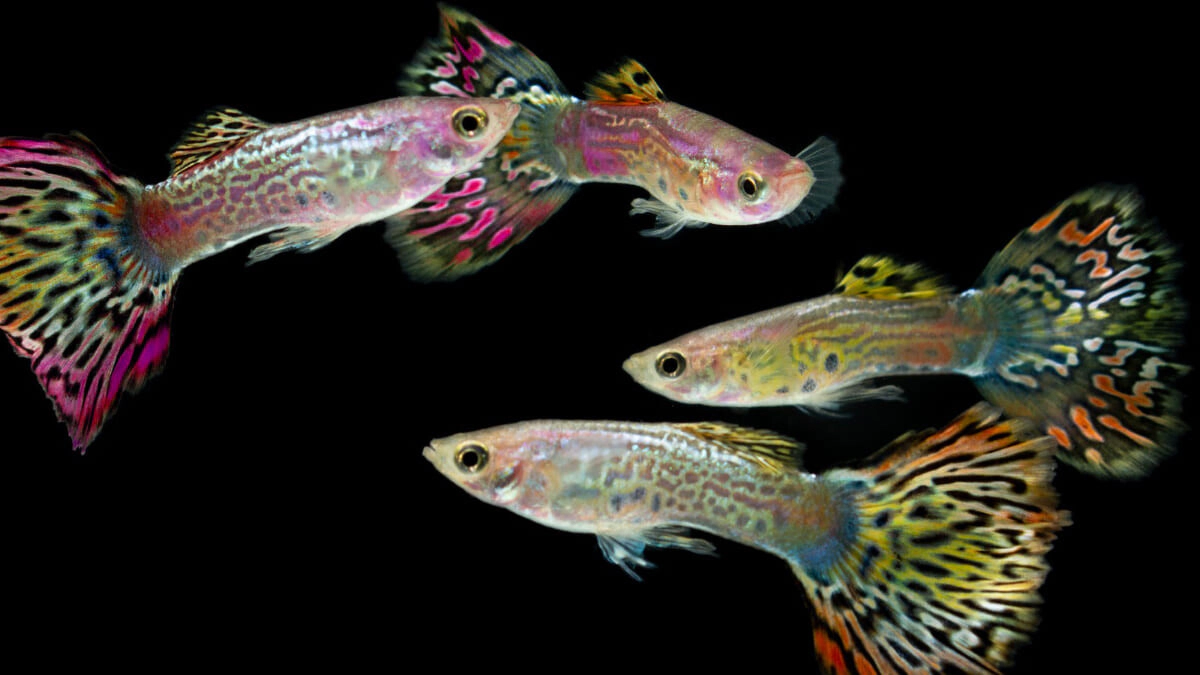
If you've noticed small fish constantly moving in your aquarium and immediately noticeable by their colors, you've probably already encountered guppy aquarium fish. With their elegant tails, vibrant colors, and lively nature, guppies are among the most popular species for those new to the aquarium hobby.
In this article, you can discover what you need to know about guppy fish care, aquarium conditions, feeding regimen, fry development, and common health problems. The guppy fish breeding process will also be discussed step by step.
Warning: This content is for general information purposes only. The care and health of guppies may vary depending on aquarium conditions and individual differences. For precise applications, support should be sought from an experienced veterinarian.
|
Scientific name |
Poecilia reticulata |
|
Care level |
Considered suitable for beginners; however, regular water monitoring is required. |
|
Aquarium volume |
A minimum of 19 liters for a single adult guppy; approximately 7.5 - 8 liters of additional volume is recommended for each additional guppy. |
|
Group arrangement |
A group of at least 3 individuals can be considered; 5 or more individuals may be preferred if the volume is suitable. |
|
Male/Female ratio |
Planning 2-3 females for each male can help reduce stress in females. |
|
Water temperature |
Generally, a range of 22-28 °C is recommended. |
|
pH range |
According to sources, it is given as approximately 6.8-8.0. |
|
Water Hardness |
The FishBase species profile includes a dH range of 9-19. |
|
Filtrasyon |
A filter suitable for the aquarium volume, that circulates the water regularly and does not tire the fish should be preferred. |
|
Beslenme |
Small portions should be given; if food residue remains at the bottom, the amount should be reduced. |
|
Reproduction |
It is a livebearer species; female guppies give birth to live fry. |
|
Fry Care |
A planted hiding place, breeding tank, or separate rearing aquarium can be considered for the fry. |
|
Main Risks |
Overfeeding, small aquarium, crowded grouping, sudden water changes, poor filtration, and adding fish without quarantine. |
|
Disease Warning |
White spots, rapid breathing, sinking to the bottom, loss of appetite, rubbing, and abdominal swelling should be carefully monitored. |
What is a Guppy? Basic Characteristics and Suitability for Beginners
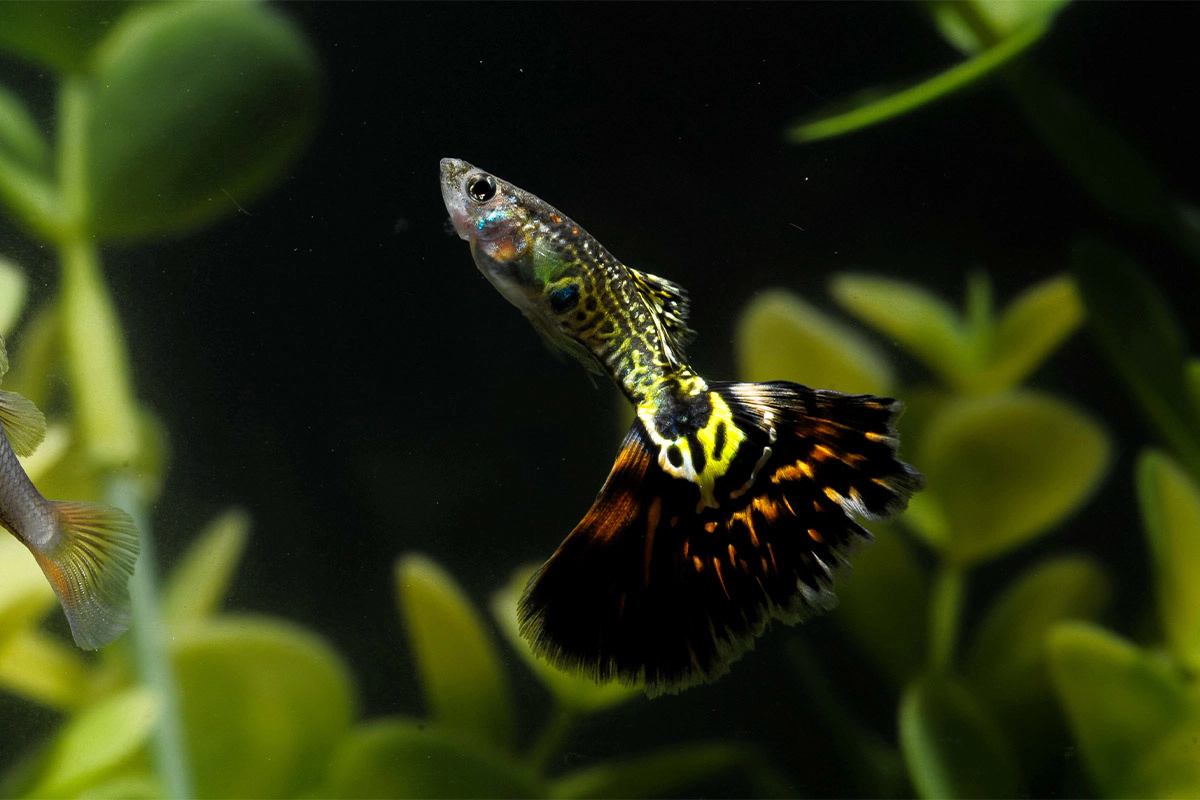
Guppies are small but eye-catching fish that add excitement to an aquarium. This species, scientifically known as Poecilia reticulata, is among the live-bearing fish. In other words, female guppies give birth to live young.
It is no coincidence that guppies are recommended for beginners. They are small, enjoyable to observe, and social fish. However, this does not mean that their care can be neglected. When water quality deteriorates, guppies, like many other aquarium fish, can be quickly affected.
Guppy Fish Species and Color Variations
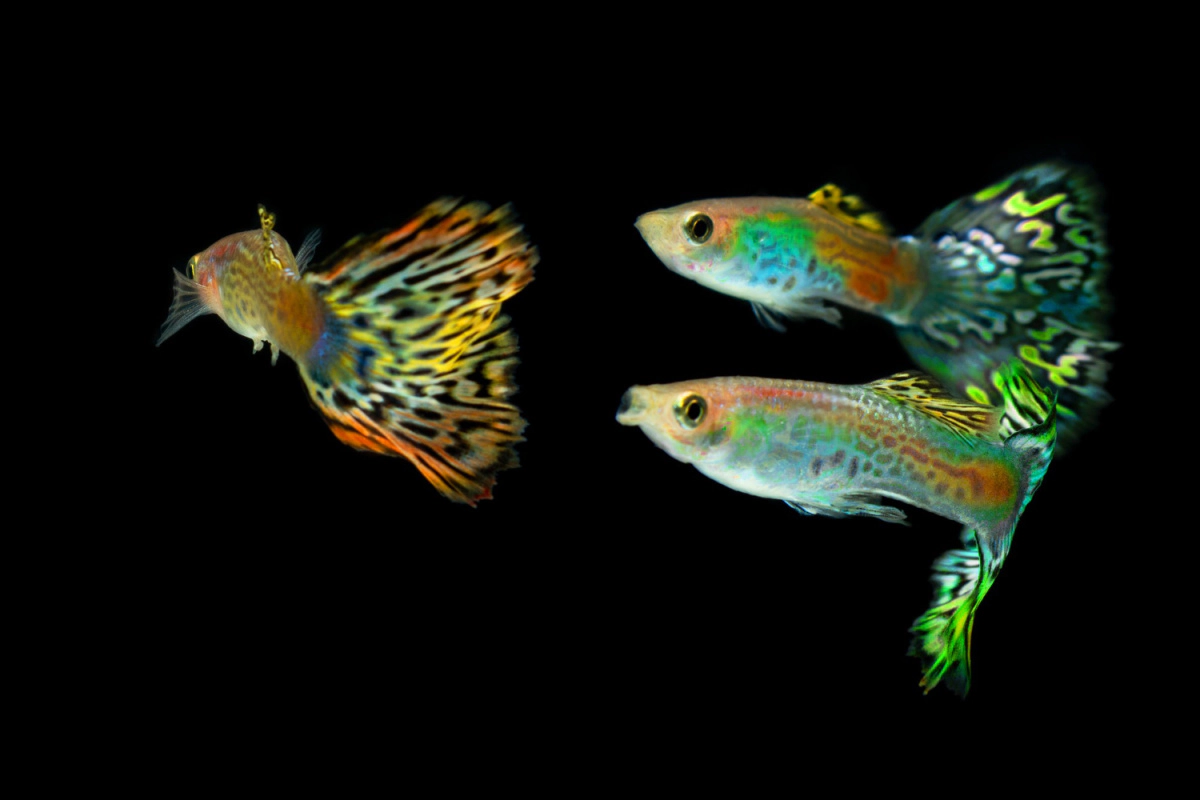
Most of the guppies we see in aquariums today are color and tail variations resulting from selective breeding. While some guppies have broad and showy tails, others stand out with the color of their bodies.
This variety makes guppy selection more enjoyable. However, looking only at color is not the right approach when making a selection. The fish should appear active, its fins should be straight, and there should be no noticeable spots or wounds on its body.
Examples of prominent guppy variations include fancy tail guppies, delta tail guppies, scarf tail guppies, mosaic guppies, leopard guppies, panda guppies, koi guppies, and albino guppies.
How to Distinguish Between Male and Female Guppies?
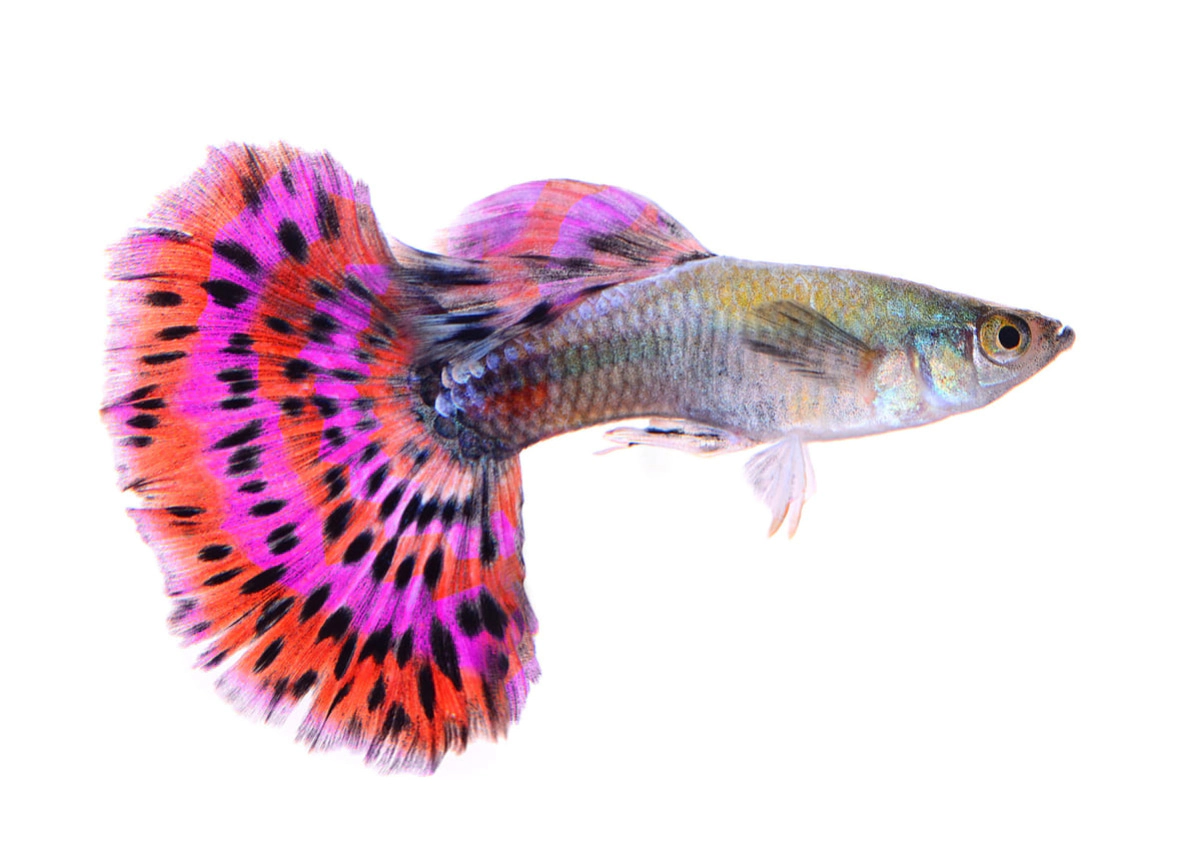
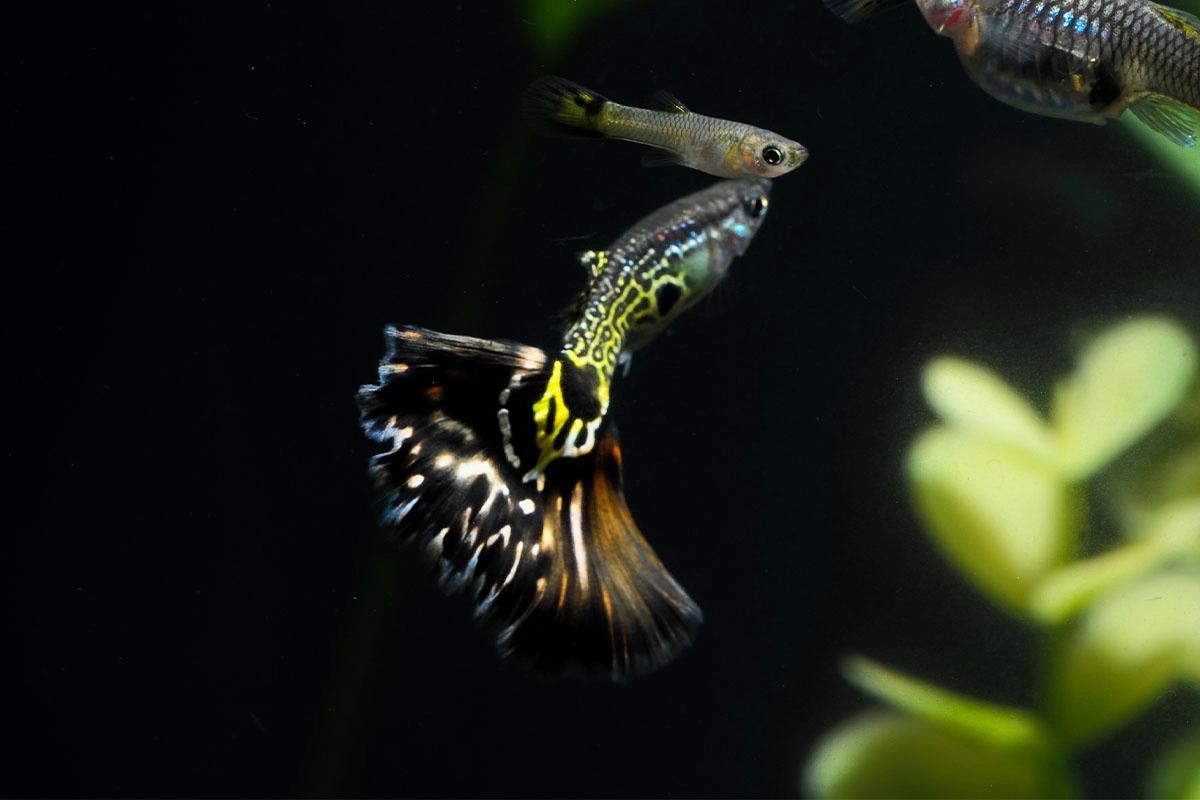
In guppies, the difference between males and females can often be determined with careful observation. Males are generally more colorful, smaller, and have thinner bodies. Their tails appear more showy.
Female guppies are generally larger and have more subdued colors. Their body structure may be fuller than males, a difference that becomes particularly noticeable in adult fish.
In male guppies, the anal fin has evolved into a gonopodium. The gonopodium is the mating organ responsible for internal fertilization. This structure is absent in females.
Distinguishing between males and females is essential for group organization in the aquarium. Frequent pursuit of females by males can create stress in females. Therefore, it is recommended to keep the number of females greater than the number of males when establishing a group.
Ideal Aquarium Setup for Guppy Fish

Guppies also need a balanced, established, and properly planned aquarium. Volume, temperature, pH, and filter setup should be considered from the start. Therefore, guppy aquarium setup should not be rushed.
According to PetMD's guppy care guide, a minimum 19-liter aquarium is recommended for a single adult guppy. Approximately 7.5 - 8 liters of additional volume should be calculated for each guppy added to the aquarium. According to this calculation, a group of three guppies requires at least a 34-liter aquarium. Since water parameters can change more quickly in smaller aquariums, choosing the largest possible volume is a safer approach.
Guppies are social fish and it is not recommended to keep them alone. While care guides recommend groups of at least 3 individuals, species profiles also include information for groups of 5 or more. Larger group arrangements can be preferred if the aquarium volume allows. If males and females are to be kept together, planning for 2-3 females for each male can help reduce stress associated with constantly monitoring the females.
When setting up a guppy aquarium, the top of the aquarium should be secured with a lid. Since guppies are jumping fish, there is a risk of them jumping out and getting injured in open aquariums.
The recommended water temperature range for guppy aquariums varies according to different sources, but is generally stated as 22-28 °C. Therefore, using a thermostatic heater and a separate aquarium thermometer is safer, especially in homes where room temperatures are variable.
Water parameters are as important as volume and temperature. FishBase species profiles give a pH range of 7.0-8.0 and dH range of 9-19 for guppies; PetMD guidelines state a pH range of 6.8-7.8. Avoiding sudden fluctuations in these values can support the adaptation of guppies to the aquarium.
Filter selection should be made according to the aquarium volume. It is recommended that the filter has the capacity to circulate the total water volume in the aquarium at least 4 times per hour. For example, in a 40-liter aquarium, a filter flow rate of at least 160 liters/hour can be aimed for. Since guppies prefer slow to moderate water movement, a strong but not tiring current should be provided.
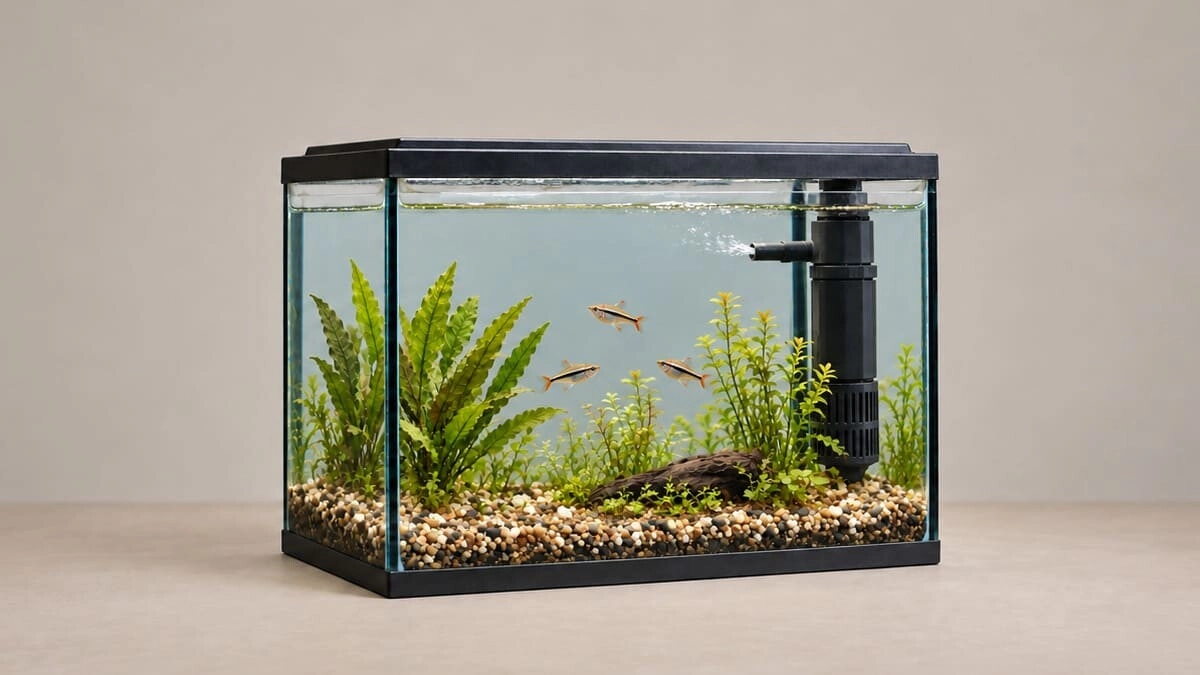
A 2.5-5 centimeter thick layer of freshwater sand or gravel can be used at the bottom. Live plants help provide hiding places. Foxtail, Amazon sword, and Elodea are among the plants that can be used in guppy aquariums. Placing plants towards the edges of the aquarium is more convenient in terms of leaving open swimming space in the middle.
How to Care for Guppy Fish?

The basis of guppy care is regular observation, balanced feeding, and monitoring water parameters. Even if the aquarium looks clean, ammonia, nitrite, and pH fluctuations can affect the fish.
Water Change and Aquarium Cleaning
Water changes should be done more consciously than simply adding or removing water from the aquarium. Adding water to replace evaporated water does not remove the old water. Therefore, the waste and organic load accumulating at the bottom should be monitored.
The MSD Veterinary Manual states that old tank syndrome can be associated with small and infrequent water changes. It is not correct to reset the entire aquarium at once during cleaning. Washing filter media vigorously with tap water can disrupt the biological balance. Gentle cleaning with water taken from the aquarium is a safer approach.
Daily and Weekly Care Routine
The basis of daily care is observing the fish. The swimming, appetite, respiratory rate, and fin position of guppies provide quick information. Stunting, hiding, or moving away from food should be noted.
If food remains in the water after feeding, the portion can be reduced. Uneaten food and organic waste can also affect water quality.
Water parameters should be checked weekly. This monitoring can be done more frequently in newly established aquariums. If ammonia or nitrite is detected, feeding should be reduced, and water changes and filtration should be reviewed.
Glass cleaning, bottom cleaning, and equipment checks can be done on the same day. However, each intervention should be performed calmly. Harsh movements can cause stress.
Aquarium Conditions That Reduce Stress for Guppies
Stress is one of the main factors that increases the risk of disease in guppies.
A quarantine plan should be considered when adding new fish to the aquarium. Even if the new fish looks healthy from the outside, it may carry parasites or infections. This risk may be more pronounced in crowded and unbalanced tanks.
Guppies are easier to observe in a tank where they are not constantly chased, have hiding places, and have a balanced current. Group structure, male-female ratio, and tank volume should be evaluated together in this respect.
Sudden temperature, pH, and water changes can be challenging for fish. Therefore, a regular but calm care approach should be applied. In a guppy aquarium, stability is more valuable than flashy equipment.
Common Mistakes in Guppy Care

Mistakes made in guppy care can be listed as follows:
Filling the aquarium with fish before the biological cycle is established: Even if the water looks clear in newly established aquariums, ammonia and nitrite can rise rapidly. This can result in lethargy, surface breathing, loss of appetite, and sudden death, especially in small and sensitive fish like guppies.
Trusting only the clarity of the water without doing a water test: Just because the aquarium water looks clean does not mean it is healthy. Maintenance performed without regularly checking ammonia, nitrite, nitrate, and pH levels often leads to problems being noticed late. Overfeeding: Since guppies are voracious fish, they are often given more food than they need. Uneaten food quickly spoils the water, increases the ammonia load, and creates a breeding ground for disease. Overcrowding the aquarium: Guppies are fast-reproducing fish. The number of fish initially considered ideal based on the chosen aquarium volume can quickly get out of control. Keeping guppies in a very small aquarium: Small bowls or aquariums with insufficient volume are not suitable for guppies. These fish are active, social, and prefer to live in groups.
Overfeeding: Guppies are gluttonous fish, and are often overfed. Uneaten food quickly spoils the water, increases ammonia levels, and creates a breeding ground for disease.
Overcrowding the aquarium: Guppies reproduce quickly. The ideal number of fish initially chosen based on the aquarium size can quickly get out of control.
Keeping guppies in too small aquariums: Small bowls or insufficiently large aquariums are not suitable for guppies. These fish are active, social, and prefer to live in groups.
Causing sudden temperature and pH changes: Although guppies are known to be hardy fish, they are sensitive to sudden changes. A sudden cooling, heating, or rapid change in pH can weaken their immunity and trigger diseases.
Using tap water without removing chlorine: Tap water should not be added directly to the aquarium. Chlorine and chloramine can damage the gills of the fish.
Neglecting filters and biological filtration: The filter is one of the most important systems for maintaining the biological balance of the aquarium. Incorrect filter selection, frequent complete cleaning, or leaving the filter closed can disrupt the balance of beneficial bacteria.
Trying to treat a sick fish in the main aquarium: Adding medication to the main tank every time a symptom appears is not correct. Some medications can harm filter bacteria and further disrupt the water balance. First, disease symptoms, water parameters, and stress factors should be evaluated together.
Adding newly acquired fish to the aquarium without quarantine: Even a healthy-looking fish from outside can carry parasites, fungal, or bacterial infections.
Using antibiotics indiscriminately for every disease: Not every problem seen in guppies is bacterial. Poor water quality, stress, parasites, improper feeding, or sudden temperature changes can also cause similar symptoms. Unnecessary antibiotic use both complicates treatment and can disrupt the aquarium balance.
Detecting diseases like white spot disease late: White spots resembling grains of salt on the fish, rubbing motion, fin tucking, or loss of appetite are early warning signs. When these symptoms are noticed, water conditions should be checked immediately and the appropriate treatment process should be started.
Leaving fry unprotected in the same environment as adults: Guppies are livebearers, but they don't care for their fry. If there isn't enough vegetation, hiding places, or a separate fry enclosure, adult fish may eat the fry.
Not taking breeding speed into account: Guppies can reproduce very quickly. Females can give birth to multiple offspring even after a single mating.
Guppy Fish Feeding
When planning guppy fish feeding, it's not enough to just determine how much food to give: The amount of food, water quality, and the fish's daily behavior should be monitored together.
What Do Guppies Eat?
Guppies feed on zooplankton, small insects, and organic remains called detritus in nature.
Guppy fish feeding should not be limited to a single type of food. High-quality foods that the fish can consume quickly and that do not disperse in the water for a long time can be preferred. If there are leftovers at the bottom after feeding, the amount should be reduced.
Feeding Differences Between Juvenile and Adult Guppies
Adult guppies should be fed in small portions. The fish's interest in food, swimming behavior, and belly appearance provide information during daily observation. Regular observation helps to detect incorrect feeding habits early.
Food size is more critical in juveniles. Large pieces may not be consumed by the juveniles. During this period, the food needs to be broken down into very small pieces.
Leftover food in the fry tank should be monitored more carefully. Food remaining in small volumes can affect water parameters more quickly. Therefore, feeding in small amounts and under control is safer.
Overfeeding and Feeding Mistakes
Overfeeding is one of the most common mistakes in guppy aquariums. Uneaten food remains in the water, increasing the organic load, while the food digested by the fish causes ammonia production through feces and respiration.
If the water becomes cloudy after feeding, if leftovers remain at the bottom, or if the fish become heavier, the feeding schedule should be reviewed. In suspicious cases, the amount of food, water test, and filter setup should be evaluated together.
Guppy Fish Reproduction Process and Fry Care

Guppies are livebearers. Therefore, the reproduction process can be quickly noticed in the aquarium. However, it should not be expected that every female guppy will produce the same number of fry at the same rate.
When and How Do Guppy Fish Reproduce?
The FishBase species profile states that females can store sperm for later fertilization. The same profile indicates that females can produce offspring approximately every 4 weeks.
The gestation period is given as 4-6 weeks. 20-40 live fry can be seen at birth. This information should be considered a general range based on the species profile.
During the breeding process, male guppies may follow females. When this behavior becomes frequent, the females may become tired. Therefore, hiding places and a balanced group arrangement are necessary in the aquarium.
Signs of Pregnancy in Guppies
Signs of pregnancy in guppies may include a more prominent abdominal area. In females, the dark triangular area between the anal and pelvic fins may become more noticeable. This appearance alone does not indicate a definite time of birth. The female's behavior, hiding tendencies, and the general arrangement in the aquarium should be monitored together.
Constantly disturbing the female near birth is not advisable. Unnecessary catching and relocation can increase stress. If a separate birthing area is to be used, the water parameters should be compatible with the main aquarium.
Protecting, Separating, and Feeding Fry
Parental care is not observed in guppies. Since parents may prey on the fry, the fry need to be protected.
For guppy fry care, densely planted areas, breeding boxes, or separate rearing aquariums can be used. When making a choice, water volume, filter flow, and the risk of fry crowding should be considered.
Fry can consume very small pieces of food. Large pieces of food may not be suitable for their mouth structure. Therefore, food should be finely crumbled, and no leftovers should be left at the bottom.
Water quality should be monitored more carefully in the fry aquarium. Excess food can quickly turn into an organic load. During this period, feeding in small amounts, in a controlled manner, and based on observation is safer.
Guppy Fish Diseases and Prevention Methods
Health problems in guppies are often not understood with a single symptom. The first step for guppy fish diseases is not to medicate the fish; It is important to calmly monitor aquarium conditions.
Most Common Guppy Diseases and Symptoms
- Fin rot: The tail and fin tips appear frayed, torn, or thinned. It is usually associated with poor water conditions.
- Fungal infection: Cotton-like white-gray formations appear on the body. It occurs more often after injury, stress, or a weakened immune system.
- White spot: Small white spots appear on the fish. The fish may rub itself against the glass, sand, or decorations; its appetite may decrease.
- Internal parasites: The fish becomes weak, its appetite decreases, and a sunken or swollen abdominal area may be observed. White and stringy feces are a noticeable symptom.
- Constipation: The abdomen swells, the fish has difficulty swimming, or may lose its balance. This is usually seen as a result of monotonous feeding and overfeeding.
- Abdominal bloating: The fish's abdomen swells noticeably, and scales may bulge outwards. This is a serious condition requiring prompt intervention.
- Ammonia-nitrite poisoning: The fish struggles to breathe at the surface, its gills move rapidly, its color fades, and sudden deaths may occur.
- Stress-related illnesses: The fish hides, its color becomes dull, its appetite decreases, and it begins to get sick frequently. Crowded aquariums, sudden water changes, and incompatible species increase stress.
Guppy Behavior and Compatible Aquarium Mates
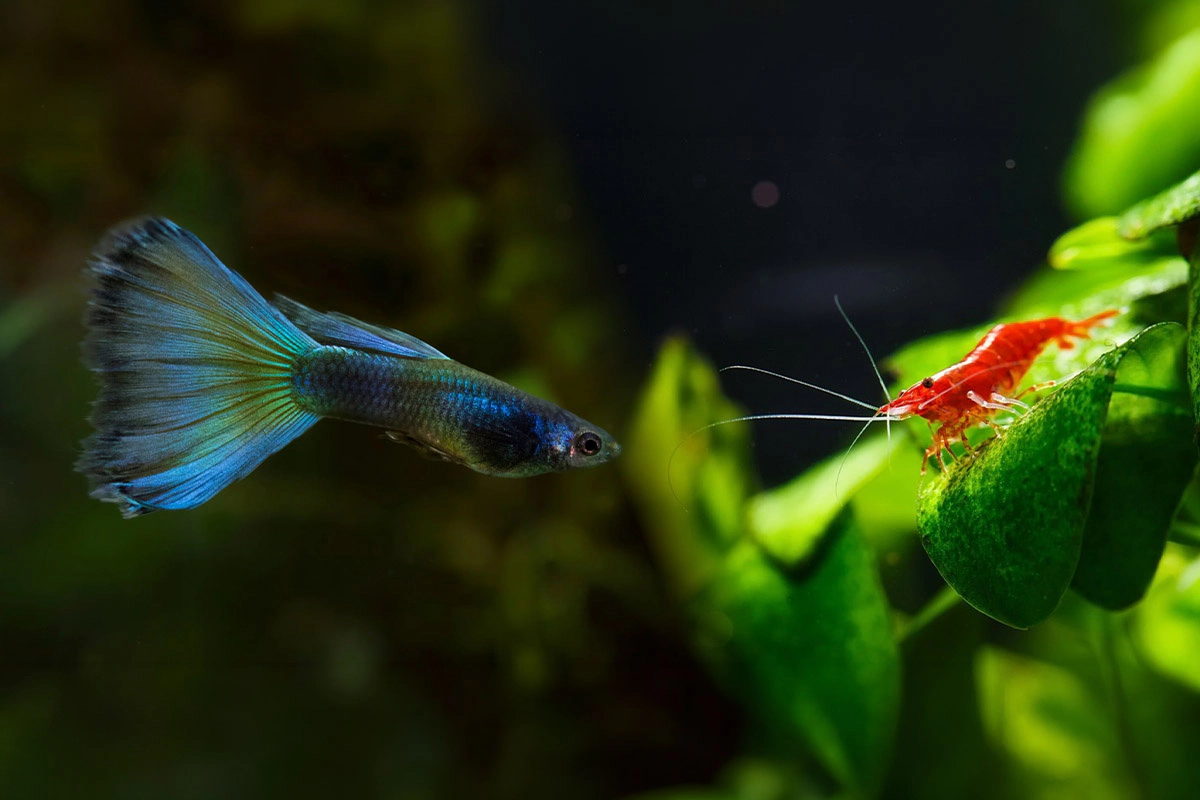
Guppies are fish that are more comfortable in groups than kept alone. A group of at least a few individuals exhibits more natural and active behaviors. Since males can frequently follow females, having more females than males in the aquarium creates a more balanced environment. Planted areas, hiding places, and a not-too-strong current also help keep females from getting stressed.
Fish Species That Can Live with Guppies
Fish that live with guppies should be chosen from small, peaceful species that can adapt to similar water conditions. Other livebearers, rasboras, Corydoras species, small loricariids, and some tetra species are among suitable options.
When choosing a compatible species, looking at the species name alone is not enough. Aquarium volume, filter power, school size, and hiding places also change the picture.
Aggressive Species to Avoid
Guppies should not be kept in the same aquarium with large, aggressive, or fin-nipping species. It is recommended to avoid species known for fin-nipping, such as tiger barb and serpae tetra.
Very large fish are also not suitable tank mates for guppies. Size difference can increase the risk of chasing and injury.
Before adding a new species to the aquarium, water parameters, behavioral compatibility, and adult size should be considered. If in doubt, calmer species should be preferred.
Choosing Guppy Fish

Choosing guppies is the most critical step before adding fish to an aquarium. Individuals that appear healthy, swim balanced, and show no signs of problems in their tank should be preferred.
The following answers can be given to the question "How to choose a healthy guppy fish?":
- Healthy guppies are active, show interest in food, and swim balanced. Fish that constantly sink to the bottom, breathe near the surface, or hide should be carefully evaluated.
- Fins should appear open and smooth. There should be no cottony formations, white spots, wounds, redness, or noticeable weakness on the body.
- The aquarium in which the fish is kept should also be examined. If there are dead fish, visibly sick fish, or cloudy water in the same tank, the purchase should be postponed.
- If buying a female guppy, the abdominal area and general behavior should be observed together. Excessive bloating does not always mean pregnancy. Parasitic problems can also change the appearance of the abdomen.
Frequently Asked Questions
What are the ideal aquarium conditions for guppies?
Guppies need a balanced, established aquarium with a filter. Guppies should not be kept alone. A group of at least 3 individuals can be considered; if the aquarium volume is suitable, a group of 5 or more individuals may be a more balanced option. The pH should be in the range of 7.0-8.0, and dH in the range of 9-19.
How should guppy fish be fed?
Small portions should be preferred. The food should be suitable for the fish's mouth structure and should not remain in the water for a long time. If food remnants are seen at the bottom, the portion should be reduced.
How often should water temperature and water changes be done for guppy fish?
The tropical temperature range given for this species is 22-28 degrees. The main goal is to avoid frequent temperature changes. Water changes should be planned according to the aquarium volume, the number of fish, and test results.
Which plants and decorations should be preferred in a guppy aquarium?
Planted areas provide a suitable setup for guppies. Females and fry can hide in these areas. Sharp-edged stones and pointed plastic decorations should be avoided.
What are the diseases and symptoms of guppy fish?
White spot, parasitic infections, bacterial problems, and problems related to water quality can occur. White spots, rapid breathing, loss of appetite, sinking to the bottom, rubbing, and abdominal swelling should be carefully monitored.
How are the breeding conditions and fry care of guppy fish ensured?
Females give birth to live young and can store sperm for later fertilization. The gestation period is between 4-6 weeks. Since guppies do not exhibit parental behavior, planted hiding places or separate rearing areas should be prepared for guppy fry.
How to choose a suitable aquarium filter for guppies?
The filter should circulate the water, help reduce the waste load, and not tire the fish with strong currents. In tanks containing fry, the filter inlet should be protected in a way that does not pose a risk to the fry.
How to choose between different types of guppies?
When choosing, health status should be evaluated before color. The fish should swim steadily, show interest in food, and have smooth fins. There should be no wounds, white spots, or cottony formations on the body.
What determines guppy prices and where should they be obtained?
Guppy prices; Color, variety, tail shape, condition, and production line can all vary. Reliable sales points with transparent and verifiable care conditions should be preferred.
Kaynaklar:
https://www.fishbase.se/summary/Poecilia-reticulata
https://www.msdvetmanual.com/exotic-and-laboratory-animals/aquarium-fish/management-of-aquarium-fish
https://www.msdvetmanual.com/all-other-pets/fish/disorders-and-diseases-of-fish
https://www.merckvetmanual.com/multimedia/table/common-environmental-hazards-for-fish
https://www.petmd.com/fish/guppy-fish-care-sheet
https://ask.ifas.ufl.edu/publication/FA084
https://dergipark.org.tr/tr/pub/aduziraat/article/278224
https://dergipark.org.tr/tr/pub/kvj/article/368485
https://www.seriouslyfish.com/species/poecilia-reticulata/
https://www.thesprucepets.com/guppy-fish-species-profile-5078901
Advertisement
Advertisement
Keep exploring
Continue reading
Aquarium & Fish
Why Does Aquarium Water Smell?
The water is clear, the fish appear normal. However, a strong odor is present when approaching the aquarium.
Read guide →
Aquarium & Fish
How to Choose Aquarium Lighting?
The whole atmosphere of an aquarium can change the moment you turn on the light. Colors become more vibrant, the depth of the water and movement…
Read guide →
Aquarium & Fish
What are Aquarium Filter Materials? In What Order are They Used?
The water cleaning power of an aquarium filter depends on the materials inside it performing their functions correctly.
Read guide →
Aquarium & Fish
What is an Aquarium Heater, How to Choose One? How Many Watts of Heater are Needed?
The water in the aquarium is the entire environment in which the fish live. Excessively cold water or frequent temperature changes can cause stress…
Read guide →