What is an Aquarium Heater, How to Choose One? How Many Watts of Heater are Needed?
The water in the aquarium is the entire environment in which the fish live. Excessively cold water or frequent temperature changes can cause stress, especially in tropical species. The primary function of aquarium heaters is not to constantly make the water warmer.
Advertisement
The water in the aquarium is the entire environment in which the fish live. Excessively cold water or frequent temperature changes can cause stress, especially in tropical species. The primary function of aquarium heaters is not to constantly make the water warmer. The device helps to maintain the water temperature within the range required by the species being kept and as balanced as possible.
Not every aquarium needs a heater. Whether an aquarium heater is needed depends on the species being kept, the room temperature, and the temperature fluctuations throughout the day.
In this article, you can find details about frequently asked questions such as how an aquarium heater works and in which aquariums it is necessary.
Warning: This content is for general information purposes only. The appropriate water temperature varies depending on the species and setup conditions.
What is an Aquarium Heater and What Does it Do?

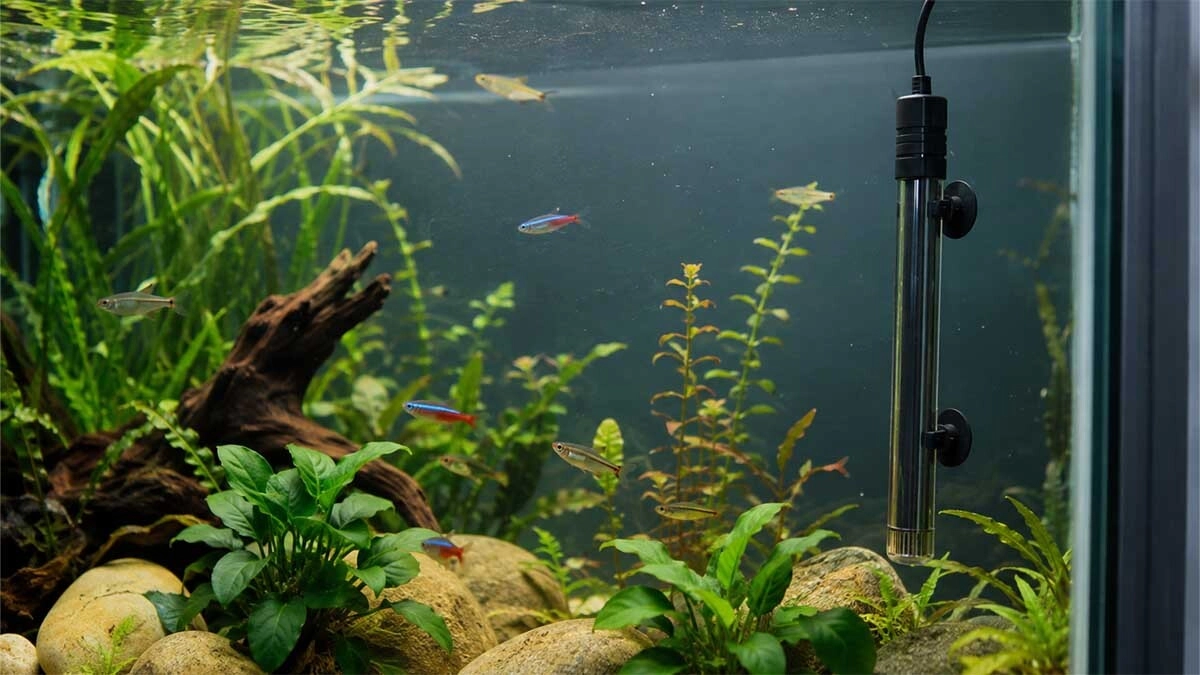
An aquarium heater is an electrical device used to maintain the water temperature within a specified range. Its heating element heats the surrounding water. The thermostat, found in many models, controls when the device will operate and stop.
According to Bunnycart's aquarium heater guide, thermostat-controlled models activate when the water temperature drops below the set value. They switch off when the target value is approached and start working again when the water cools down. Therefore, the device is not expected to produce heat continuously.
The benefit of the heater is not to make the water as hot as possible, but to maintain the selected temperature range. When the room cools down at night or the temperature drops in winter months, the aquarium heater continues to operate in the same manner. Thus, it is not necessary to constantly turn the heater on and off throughout the day.
Important: Sudden temperature changes can cause stress in fish and increase their susceptibility to certain infections.
Is a Heater Necessary in Every Aquarium?

No, a heater is not necessary in every aquarium. As mentioned earlier, the need is determined by the temperature requirements of the fish being kept and the room's ability to maintain that temperature throughout the day.
The main distinction is between tropical species and temperate or cold water species. Tropical fish such as guppies, angelfish, and bettas generally need warmer and more stable water conditions than room temperature. If the environment cannot consistently provide these conditions, a heater is necessary.
In aquariums inhabited by temperate or cold water species such as goldfish, a heater is often not needed. However, it is not correct to say that "a heater should never be used in a goldfish aquarium." If the room gets too cold or the water temperature fluctuates significantly, the tank conditions should be re-evaluated.
The house being warm is also not a sufficient criterion on its own. The room may stay warm during the day and cool down at night. Seasonal changes can also affect the aquarium temperature.
The most accurate approach is to learn the temperature range required by the species and monitor the water with a thermometer. If the water remains within the appropriate range and is balanced, a heater may not be necessary. If the temperature drops below this range, a thermostat-controlled model can be used.
What Should Be Considered When Choosing an Aquarium Heater?

The following criteria should be considered together for the correct aquarium heater selection:
- Actual water volume: The amount of water inside may not match the capacity stated on the aquarium label. Sand, rocks, decorations, and empty spaces reduce the usable volume.
- Required temperature increase: The water temperature required by the fish should be compared with the lowest temperature the room can reach in winter. As the difference increases, the heat loss that the device must compensate for increases.
- Whether the tank is open or covered: Tanks without lids can lose heat faster depending on ambient conditions. It is possible that two tanks of the same volume may require heaters of different power.
- Thermostat specifications: The setting range and temperature adjustment capability of the heater thermostat should be checked. In setups with varying temperature requirements, a constant temperature model may be limiting.
- Submersion and mounting limitations: Not every model is suitable for complete submersion. Information on vertical or horizontal use with minimum water levels should be checked in the product instructions.
- Manufacturer's capacity recommendation: The tank volume indicated on the product is a useful starting point. However, this value does not replace room temperature and target water temperature.
- Material and compatibility: The heater's body structure must be suitable for the type of water and tank conditions in which it will be used. The product's cable and body must be free from any damage.
If you are choosing the heater as part of a new tank, you can also consider other essential aquarium equipment within the same plan.
What are the types of aquarium heaters?

Aquarium heaters are categorized according to temperature adjustment capabilities and how the device is placed in the water.
Ayarlanabilir Termostatlı Isıtıcılar
The adjustable aquarium heater allows the user to select a specific target temperature. The thermostat activates the device when the water temperature drops below the set value. It stops heating when the target temperature is approached.
These models offer more flexible use for fish with different temperature requirements. The temperature setting can be changed according to the season or installation conditions. The value displayed on the adjustment knob should be checked against the actual water temperature using a thermometer.
Sabit Sıcaklıklı Isıtıcılar
Fixed temperature models operate within a temperature range determined by the manufacturer. The user cannot change the target temperature.
These products may be practical in simple installations where the fixed setting is compatible with the needs of the fish. However, they do not offer an adjustment option when a different temperature is needed. The target temperature and tolerance range of the product should be checked before purchasing.
Fully Submersible and Partially Submersible Heaters
Aquarium submersible heater models can operate completely underwater according to the manufacturer's instructions. If the submersible aquarium heater is to be placed vertically, horizontally, or at an angle, the mounting direction permitted by the product should be followed.
In partially submersible models, a certain part of the device remains above the water. It should not be assumed that the product can be completely submerged based on its appearance. Minimum and maximum water level markings on the housing should be taken as a basis.
Heaters Connected to the External Filter Line
In-line, external aquarium heaters are connected to the hose line of the external filter. The water is heated as it passes through the filter system and is returned to the aquarium. They do not take up space in the tank. Hose diameter, flow direction and compatibility with the filter should be checked from the manufacturer's information.
Filter Systems with Integrated Heaters
In some external filters, the heating element is integrated into the filter housing. These systems can reduce the visibility of the equipment inside the tank. Since the heater and filter are connected to a single system, maintenance, malfunction and capacity information should be evaluated together.
How Many Watts of Heater is Needed for an Aquarium?

The required wattage for an aquarium is determined by considering the tank volume and the required water temperature. Wattage indicates the power rating of the device. Higher wattage offers greater heating capacity; however, it doesn't necessarily mean it's the right choice for every tank.
Charterhouse Aquatics gives approximately 1 W/L as a starting point for normally heated rooms. The Spruce Pets recommends a range of approximately 0.7–1.3 W/L depending on the required temperature increase. These values are not definitive. The manufacturer's recommendations for tank volume and ambient conditions should also be checked.
How Do Aquarium Volume and Room Temperature Affect Wattage Selection?
The aquarium heater wattage calculation should begin by finding the difference between the target water temperature and the lowest room temperature.
For example, if the water needs to be 25°C and the room cools down to a maximum of 20°C, the temperature difference is 5°C. If the room drops to 15°C in winter, the difference that needs to be compensated for in the same tank increases to 10°C.
Even if the two tanks have the same volume, the second tank may need a more powerful heater.
In the calculation, the lowest temperature that the room where the aquarium is located can reach should be used instead of the average temperature of the house. Tanks without lids, locations close to drafts, and colder rooms can increase heat loss. In these conditions, the initial value found according to the liters may not be sufficient.
Aquarium Heater Wattage Chart by Literage
This chart from The Spruce Pets is a general starting point for an approximate temperature difference of 5°C. The capacity ranges given by manufacturers for the same wattage may vary. The model's own capacity chart should be used as the basis for purchasing decisions.
|
Water volume in the aquarium |
Starting watt range |
|
20 liters |
25 W |
|
30 liters |
25–50 W |
|
50 liters |
50–75 W |
|
75 liters |
75 W |
|
100 liters |
75–100 W |
|
150 liters |
100–150 W |
|
200 liters |
150–200 W |
|
300 liters |
250–300 W |
Is a Higher Wattage Aquarium Heater Better?

No, a higher wattage heater is not better for every aquarium. The wattage does not indicate the quality, durability, or reliability of the device. It indicates how much heating power the device offers.
A model with insufficient capacity may not reach the target temperature or may have to operate for a long time. A model with insufficient capacity, on the other hand, will reach the target and shut off when the thermostat is working correctly. However, choosing a power level much higher than needed does not provide a significant benefit. It can also increase the risk of the water heating up faster in case of thermostat failure.
The correct aquarium heater power should be sufficient to compensate for the heat loss of the tank. For example, choosing 200 W for a 50-liter tank in a moderately warm room does not guarantee a better result than the 50-75 W range determined by proper calculation.
Should One or Two Heaters Be Used in Large Aquariums?

In large aquariums, both a single heater and two smaller heaters can be used. Using two devices is not mandatory. The decision is up to you. The choice should be based on the tank's size, shape, water circulation, and redundancy requirements.
If two heaters are to be used, the total required wattage should be divided between the devices. For example, if the calculated need is 300 W, two 150 W models can be chosen.
Placing the heaters in different areas of the tank can help distribute the temperature more evenly. If one device stops working, the other can slow down the rapid cooling of the water. However, the remaining device may not be able to maintain the target temperature alone.
The Aquarium Science guide recommends using two low-power heaters as a redundancy method to mitigate the risk of failure. A single model with the correct capacity can also be a suitable choice if the temperature remains balanced throughout the tank.
Where Should the Aquarium Heater Be Placed?
The aquarium heater should be placed in a circulating water area where heated water can be distributed throughout the tank. Areas near the filter outlet are considered suitable in most installations.
Simplicity Aquatics states that placement may vary depending on the filter system. In the bottom filter chamber, called the sump, the heater can be placed in an area with strong water flow. In systems where the filter is located inside the tank, the device can be kept in the main circulation area.
Although the heater can be placed next to the filter, it should not obstruct water flow or put pressure on the filter components. Placing it between decorations or embedding it in the substrate can also make it difficult for heat to be distributed evenly.
Not all aquarium heater models are suitable for vertical, horizontal, or angled use. Therefore, the manufacturer's instructions should be followed for the mounting direction. The minimum water level line of the device should always remain below the water level.
What Temperature Should an Aquarium Heater Be Set To?

There is no single correct temperature to set a heater to. The target temperature is determined by the needs of the fish living in the aquarium, not the model of the device.
Chewy's aquarium heating guide gives an approximate range of 24–27 °C for tropical freshwater fish. For saltwater fish, it is approximately 26–27 °C, and for cold-water species such as goldfish, the range is 18–24 °C.
These values are general ranges for broad groups of organisms. The temperature requirements of each species within the same group may not be the same. When determining the correct aquarium water temperature, the care information prepared for the species being kept should be checked.
Important: As water temperature increases, the water's capacity to hold dissolved oxygen decreases. If aeration and water circulation are insufficient, the risk of oxygen stress in fish may increase. In mixed aquariums, the appropriate temperature ranges for all species should be compared. If the ranges overlap, a common value can be chosen. If they do not overlap, determining a single middle range does not mean that the organisms are compatible.
After adjustment, the water temperature should be verified with an independent thermometer. Sudden and frequent temperature changes should be avoided.
Is a Thermometer Necessary When Using an Aquarium Heater?

Yes. An aquarium thermometer monitors the actual water temperature independently of the heater's setting. The thermostat manages when the device operates. The thermometer measures the temperature of the water in the tank. The function of these two pieces of equipment is not the same.
The thermometer should not be placed directly next to the heater. It should be positioned in a location that reflects the overall temperature of the tank. When changing the heater setting, the thermometer should be used to monitor whether the water has reached the target temperature.
According to Aquacadabra's heater guide, digital models may have a display and temperature sensors. However, there may still be a difference between the value displayed by the device and the actual water temperature. Independent measurement makes it easier to detect this difference or a possible malfunction.
How to Use the Aquarium Heater Safely?

For safe use, the electrical connection, water level, and body condition of the device should be checked regularly.
Follow the initial operation sequence: Secure the device to the full aquarium in the direction permitted by the manufacturer. Check the minimum water level mark. Observe the manufacturer's specified waiting time before plugging in. After unplugging, allow the appliance to cool before removing it from the water.
Secure electrical connection: Connect the heater to an accessible socket protected by a residual current device. Unplug any electrical equipment in the aquarium before attempting to repair it. Do not attempt to repair a damaged cable.
Do not operate outside of water: Models designed for underwater use must be submerged in water to the manufacturer's specified level while operating.
Switch off before water changes: The Hygger heating guide recommends switching off the appliance before lowering the water level. Unplug and wait for the manufacturer's specified cooling time.
Protect from sudden temperature changes: Do not allow the heated glass body to come into direct contact with cold water. This may cause the glass to crack.
Inspect the housing and cable: Do not use the product if it has cracks, melting, loose connections, or cable damage. Do not restart the device if you suspect water has entered the housing.
Protect the outlet from water: The cable should form a drip loop downwards before reaching the outlet. This reduces the risk of water from the cable reaching the outlet.
Evaluate the independent temperature controller: In setups with large, delicate creatures, an external controller can provide added safety. The controller should also be installed according to the manufacturer's instructions.
Follow the manufacturer's instructions: Since the submersion limit, mounting direction, and maintenance method may vary depending on the model, the instructions specific to the preferred aquarium heater model should be followed.
What are the mistakes made when choosing an aquarium heater?

Mistakes made during aquarium heater selection can lead to insufficient heating or temperature fluctuations that are difficult to control.
- Choosing wattage solely based on tank volume and not taking into account the lowest room temperature.
- Mistaking a high wattage value for a higher quality or more suitable product.
- Setting the target temperature without knowing the temperature requirements of the fish.
- Accepting the tank capacity on the label as the actual water volume.
- Not checking the manufacturer's recommended volume, submersion limit, and mounting direction.
- Not verifying the heater setting with an independent thermometer.
- Placing the device in an area with poor water circulation.
- Continuing to use a product with a cracked casing, melting, or cable damage.
Frequently Asked Questions

How long does it take for an aquarium heater to heat the water?
The heating time of the aquarium varies depending on the tank volume, initial temperature, target temperature, heater wattage, and room conditions. A single standard time cannot be given. The temperature should be monitored with an independent thermometer.
Why does the aquarium heater light blink?
The meaning of the indicator light varies depending on the model. In some heaters, the light indicates that the device is actively heating. In digital models, a flashing light may indicate a different operating status or warning. The product's instruction manual should be checked. S070928 Should the aquarium heater be removed in summer? It is not necessary to automatically remove the heater in summer. If the water temperature remains within the appropriate range for the species, the thermostat-controlled device will not heat. The temperature should be monitored with a thermometer, and if overheating is observed, the ambient conditions should be evaluated. Can the aquarium heater remain on continuously? Models with thermostats can be designed to remain continuously connected to the power supply. The heating element operates and switches off according to the target temperature. The manufacturer's instructions should be checked. Is it normal for the heater to operate continuously?
Should the aquarium heater be switched off in the summer?
It is not necessary to automatically switch off the heater in the summer months. If the water temperature remains within the appropriate range for the species, the thermostat-controlled device will not heat. The temperature should be monitored with a thermometer, and if overheating is observed, the ambient conditions should be evaluated.
Can the aquarium heater remain on continuously?
Thermostat-controlled models can be designed to remain continuously connected to the power supply. The heating element operates and switches off according to the target temperature. The manufacturer's instructions should be checked.
Is continuous operation of the heater normal?
The device may run for an extended period during the initial heating phase. If it does not switch off after reaching the target temperature, the capacity, placement, and device condition should be checked.
Can tropical fish be kept without a heater?
It may be possible if the room can maintain the species' temperature range throughout the day. A single temperature measurement does not reflect seasonal and nighttime variations.
Can a submersible aquarium heater be operated outside of the water?
No. Submersible models designed to operate underwater may overheat or be damaged outside of the water. The device should be unplugged and allowed to cool before any water changes.
Kaynaklar:
https://www.bunnycart.com/blog/everything-you-need-to-know-about-aquarium-heaters/
https://aquacadabra.com/blogs/news/heating-your-aquarium
https://www.hygger-online.com/aquarium-heating-basics-part-one
https://aquariumscience.org/14-8-aquarium-heaters/
https://www.simplicityaquatics.com/blog/how-to-choose-an-aquarium-heater/
https://www.chewy.com/education/fish/general/how-to-heat-your-home-aquarium
https://charterhouse-aquatics.com/blogs/help-guides/choosing-the-right-heater-for-your-aquarium-freshwater-marine
https://www.thesprucepets.com/aquarium-heater-size-guide-1381033
https://www.tetra.net/fileadmin/pictures/TH53436_9074.pdf
Advertisement
Advertisement
Keep exploring
Continue reading
Aquarium & Fish
Why Does Aquarium Water Smell?
The water is clear, the fish appear normal. However, a strong odor is present when approaching the aquarium.
Read guide →
Aquarium & Fish
How to Choose Aquarium Lighting?
The whole atmosphere of an aquarium can change the moment you turn on the light. Colors become more vibrant, the depth of the water and movement…
Read guide →
Aquarium & Fish
What are Aquarium Filter Materials? In What Order are They Used?
The water cleaning power of an aquarium filter depends on the materials inside it performing their functions correctly.
Read guide →
Aquarium & Fish
How to Choose Aquarium Sand? How Many Kilograms of Sand Are Needed for an Aquarium?
Aquarium sand is often chosen based on its color, grain appearance, or package weight. However, similar-looking substrate materials can produce…
Read guide →