Is My Cat Coughing or Trying to Pass a Hairball?
Seeing your cat crouch down, stretching its neck, and trying to expel something with a strange sound can be unsettling. The same scene sometimes indicates a cough, sometimes an attempt to expel a ball of fur, and the two situations are often confused because they look similar.

Advertisement
Seeing your cat crouch down, stretching its neck, and trying to expel something with a strange sound can be unsettling. The same scene sometimes indicates a cough, sometimes an attempt to expel a ball of fur, and the two situations are often confused because they look similar.
Although the symptoms are similar, these two are not the same thing. True coughing is related to the respiratory tract. Hairball expulsion, on the other hand, is a gagging and vomiting process that develops through the digestive system.
This article provides information on how to distinguish between coughing and hairball expulsion in cats and when a veterinary evaluation is necessary.
Warning: This content is for general informational purposes only. The course of the condition may vary from cat to cat. Consult your veterinarian for a definitive assessment of your cat's condition.
How to Tell the Difference Between Cat Coughing and Hairball Expulsion?

The most important difference between coughing and hairball expulsion is which movement dominates the attack. When a cat coughs, it expels air from its respiratory tract suddenly and noisily. When trying to expel a hairball, gagging, vomiting, and pronounced abdominal contractions become prominent. The expulsion of a mass of hair at the end of the attack strongly suggests a hairball. However, it is not always possible to make a decision based solely on the cat's crouching or the sound it makes. A severe cough may end with gagging, and a cat trying to expel a hairball may not be able to expel hair on every attempt. Therefore, evaluating the dominant movement, abdominal contractions, and how the attack ends together provides the most accurate approach. How Does a Cat Behave When Coughing? A coughing cat usually crouches, brings its chest close to the ground, and extends its neck forward. The cough sound may be dry. Some cats may experience discharge or the attack may end with gagging. The duration and behavior after the attack vary from cat to cat. Often, no hair comes out of the mouth.
However, it's not always possible to judge solely by whether the cat is crouching or the sound it makes. A strong cough might end in gagging, and a cat trying to expel a hairball might not succeed on every attempt. Therefore, evaluating the dominant movement, abdominal contractions, and how the attack ends together provides the most accurate approach.
How Does a Cat Behave When Coughing?
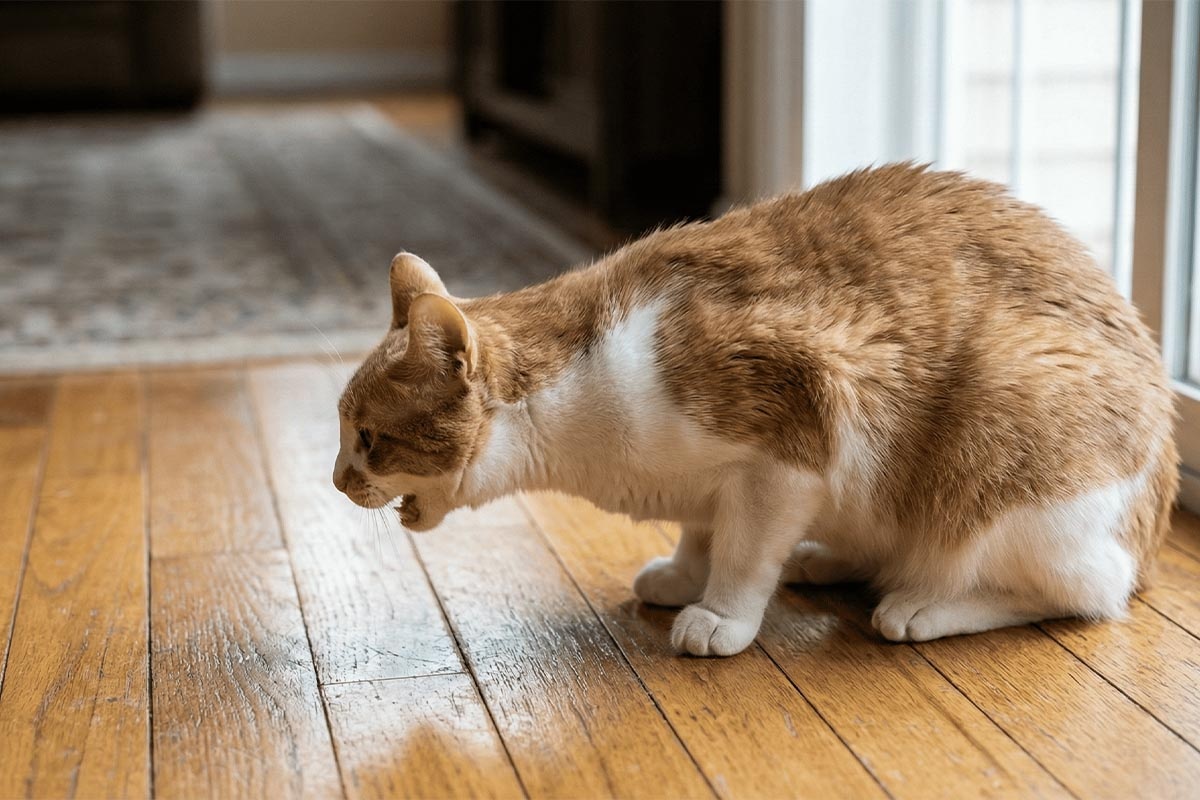
A coughing cat will often crouch, bring its chest close to the ground, and extend its neck forward. The cough sound may be dry. In some cats, saliva may be present, or the attack may end in gagging. The duration and behavior after the attack vary from cat to cat. Often, no hair comes out of the mouth.
This position is easily confused with hairball expulsion behavior. It is not accurate to make a definitive distinction based solely on body posture. The sound and the rest of the process must also be observed.
How Does a Cat Behave When Expelling a Hairball?
The prominent movement when expelling a hairball is gagging. The abdominal muscles contract significantly, and the body moves rhythmically back and forth. At the end of the attack, a dense mass of hair, some fluid, or stomach contents may come out.
The expelled hairball does not always resemble a round ball as its name suggests. Because it forms as it passes through the esophagus, it is usually long, thin, and cylindrical in shape; in fact, it can be mistaken for feces at first glance. Its color is generally close to the cat's fur, but it may appear darker due to stomach fluids and food residue. A common misconception is that hairballs are expelled by "coughing up." Technically, this is not true. The process essentially involves gagging and vomiting. Important: The table we have shared below is a quick differentiation guide. Symptoms alone do not provide a definitive diagnosis.
A common misconception is that hairballs are expelled by "coughing." Technically, this is not true. The process primarily involves gagging and vomiting.
Important: The table below is a quick guide to differentiation. Symptoms alone do not provide definitive diagnoses.
|
Feature |
Coughing |
Removing Hairballs |
|
Dominant movement |
Sudden and noisy expulsion of air |
Gagging and vomiting movements |
|
Abdominal movements |
May be present but usually not dominant |
May be rhythmic and more pronounced |
|
Cat's posture |
Squatting and neck forward can prolong |
Crouching and moving the body forward may be observed |
|
What happens at the end of the attack? |
Often no hair comes out of the mouth |
Hair mass, fluid or stomach contents may come out |
|
The strongest clue |
Coughing movement is dominant |
Gagging/vomiting is dominant and hair comes out |
Why Do Cats Cough?

A true cough is a response to a stimulus in the respiratory tract and can occur for many different reasons.
Asthma and Lower Respiratory Tract Problems
One of the common causes of recurrent cough in cats is feline asthma. In this condition, the bronchi leading to the lungs become inflamed and narrowed. The narrowed airways trigger coughing, and attacks may sometimes be accompanied by wheezing. Symptoms may fluctuate periodically. The recurrence of attacks after a seemingly good period is not a reason to underestimate the condition.
Infections, Parasites, and Other Respiratory Tract Problems
Respiratory tract infections or certain parasitic agents can also be behind a cough. These can irritate the airways and trigger a cough response. The severity and course of symptoms vary depending on the causative agent.
Foreign Objects, Dust, Smoke, and Environmental Irritants
Sometimes a small piece of foreign material that enters the airway can also cause similar irritation. For example, an inhaled plant fragment or other foreign object can irritate the airways, triggering a sudden or persistent cough.
A single cough does not indicate a specific disease. Cigarette smoke, dense dust, aerosol sprays, strong cleaning scents, and pungent perfumes can irritate the airways. If the cough is recurrent or accompanied by other symptoms, a veterinary evaluation is necessary.
What to Observe in a Cat That Pretends to Cough?

Since the attack may not be visible during examination, details you record at home will help the veterinarian's evaluation.
Duration and Frequency of Attacks
Try to remember when the attack started and establish a time frame. How many times a day or week does it recur, how long does each attack last approximately, and does it occur after a specific event? Monitoring whether it becomes more frequent over time provides valuable clues about the course of the attack. Keeping short notes of these observations will make your job easier during the examination.
Accompanying Symptoms
Coughing or gagging is not meaningful on its own, but only when accompanied by other findings. Observe the following symptoms: wheezing, sneezing, runny nose, vomiting, changes in appetite, weakness, weight loss, and significant differences in breathing. Which of these appear together is fundamental to evaluating the overall picture.
If possible, record a short video of the attack. The sound of the movement, its duration, and the cat's posture provide a concrete basis for the veterinarian to distinguish between coughing and gagging.
When to See a Veterinarian When Your Cat Coughs?
Some signs indicate severe respiratory distress and are not suitable for waiting. This group includes accelerated breathing at rest, marked respiratory effort, open-mouth breathing, and progressively increasing difficulty breathing. A bluish discoloration of the gums or tongue is an urgent sign and indicates insufficient oxygen to the tissues.
Caution: If you see any of these signs or if the cat's general condition rapidly deteriorates, do not wait to observe. Contact a veterinarian as soon as possible.
It is also important to be aware of non-urgent but not neglectable symptoms. A cough that lasts for days or is repeated, persistent gagging without being able to expel anything, accompanied by loss of appetite or lethargy, requires veterinary evaluation.
Persistent and unremitting gagging isn't always a sign of a simple hairball. Rarely, it can be a symptom of more serious conditions, such as a digestive tract obstruction.
What can be done to reduce hairball formation in cats?

To understand the steps to reduce hairballs, you first need to know how they form. An effective cat grooming routine can help manage existing hairballs and also reduce the risk of hairball formation.
How do hairballs form?
The story of the hairball actually begins with a cat's daily grooming routine. While grooming themselves, cats swallow some loose hairs that get caught on their tongues. Most of these hairs travel through the digestive tract and are naturally expelled from the body. However, not every hair completes its journey so smoothly.
Some hairs that cannot pass through the digestive system can accumulate in the stomach and, over time, tangle together to form a dense mass. This is what we see as a hairball. When the cat tries to expel this accumulation, gagging and vomiting movements occur; therefore, this situation can easily be confused with a cough.
Not only the amount of hair, but also how frequently the cat licks itself and how the hairs move through the digestive tract are important in hairball formation. Therefore, hairball control focuses on two main points: reducing the amount of loose hair the cat swallows and supporting the passage of swallowed hairs through the digestive tract.
Which Cats Are More Prone to Hairballs?
First of all, we must accept that we cannot completely prevent cats from swallowing hair. Every cat swallows hair, but some cats may be more prone to hairballs. Cats with long, dense fur are at the top of this group. Especially during periods of increased shedding, the amount of hair a cat swallows while grooming itself may also increase.
Another point to consider here is excessive licking. A cat that licks itself more than usual due to itching, skin problems, allergies, stress, or pain will naturally swallow more hair. Therefore, if hairballs are becoming more frequent, it is necessary to look not only at the length of the fur but also at whether there is a change in the cat's licking behavior.
Regular Brushing and Grooming
One of the most practical steps in combating hairballs is to make brushing a regular part of the grooming routine. Every loose hair left on the comb means that some of the hair that the cat might swallow while grooming itself is removed beforehand.
The aim here is not to change the cat's natural grooming behavior, but to reduce the amount of loose hair it can swallow. Brushing frequency doesn't have to be the same for every cat; a suitable grooming routine can be established based on coat type, shedding intensity, and the cat's response to brushing.
How Can Nutrition Support Hairball Control?
Nutrition can also provide significant support in the natural elimination of swallowed hair from the body as it moves through the digestive tract. Therefore, some cat foods formulated with hairball control in mind include fiber sources that can help support the passage of swallowed hair through the intestines.
When choosing food, it's necessary to consider not only the cat's tendency to form hairballs, but also its age, life stage, general health status, and nutritional needs. Hairball control cat foods, developed especially for cats that frequently swallow hair or have hairball problems, can be considered in conjunction with a proper grooming routine.
While some loose hairs can be removed before they are swallowed by the cat through regular brushing, foods designed to minimize hairballs can also help swallowed hairs move through the digestive system. Thus, hairball control is not based on a single step, but on a more holistic routine where grooming and nutrition are carried out together.
Frequently Asked Questions
Is coughing normal in kittens?
Coughing in kittens is not a spontaneously normal occurrence and its cause should be investigated. Because a developing immune system can be more susceptible to infections, coughing in kittens should be handled more carefully than in adults. If it recurs or is accompanied by other symptoms, a veterinarian should be consulted.
Why does my cat cough at night?
A cough noticed at night alone does not indicate a specific cause. Record the time of the attack, the activity beforehand, and any recent changes in the environment. If the cough becomes more pronounced or frequent at night, a veterinary evaluation with a video recording may be helpful.
How often do cats pass hairballs?
There is no single normal frequency that applies to all cats. Newly started, frequent, or unresolved retching; if accompanied by vomiting, decreased appetite, or lethargy, a veterinary evaluation is necessary.
What should be done if the cat cannot pass a hairball?
Avoid administering random medications or laxatives at home. Laxatives should not be given without veterinary supervision. If recurrent and unresolved retching, vomiting, loss of appetite, or general malaise occur, consult a veterinarian immediately. This condition may sometimes indicate more than just a simple hairball.
Kaynaklar
https://www.merckvetmanual.com/respiratory-system/respiratory-diseases-of-small-animals/feline-bronchial-asthma
https://www.vet.cornell.edu/departments-centers-and-institutes/cornell-feline-health-center/health-information/feline-health-topics/danger-hairballs
https://vcahospitals.com/premier/know-your-pet/coughing-in-cats
https://vcahospitals.com/know-your-pet/trichobezoars-in-cats
https://www.merckvetmanual.com/cat-owners/lung-and-airway-disorders-of-cats/introduction-to-lung-and-airway-disorders-of-cats
https://vcahospitals.com/know-your-pet/inhalant-treatment-for-feline-asthma-and-bronchitis
https://www.vet.cornell.edu/departments-centers-and-institutes/cornell-feline-health-center/health-information/feline-health-topics/hairy-dilemma
Advertisement
Advertisement
Keep exploring
Continue reading

Cat Care
York Chocolate Cat Characteristics, Care and Temperament
With its dark brown fur, watchful eyes, and observant demeanor, the York Chocolate is a cat that sparks curiosity at first sight.
Read guide →
Cat Care
Tiffanie Cat Characteristics, Care and Temperament
Silky fur, on its neck With its frilly mane and large, curious eyes, the Tiffanie cat immediately catches the eye.
Read guide →
Cat Care
Snowshoe Cat Characteristics, Character and Care
The Snowshoe cat is a unique breed developed by the controlled mating of Siamese cats and American Shorthair cats.
Read guide →
Cat Care
Pixiebob Cat Characteristics, Care and Temperament
The desire to participate in the daily routine of its family is one of the most striking aspects of the Pixiebob cat's character.
Read guide →