The Importance of Fiber in Cat Food: Its Role in Digestion, Hairballs, and Weight Control
Most people just glance at the "crude cellulose" line in the analysis table on the cat food packaging. However, the component represented by that line, namely fiber, is a versatile group of carbohydrates that regulates the rhythm of the digestive system, nourishes the intestinal flora, and shapes…

Advertisement
Most people just glance at the "crude cellulose" line in the analysis table on the cat food packaging. However, the component represented by that line, namely fiber, is a versatile group of carbohydrates that regulates the rhythm of the digestive system, nourishes the intestinal flora, and shapes the feeling of fullness.
Fiber is not considered an essential nutrient for cats in the classical sense. However, it is still present in almost all modern commercial cat foods in a certain amount. This is because the benefits it provides can far outweigh its caloric value.
Warning: This content is for general informational purposes only. Every cat's age, breed, health history, and digestive sensitivity are different. A definitive assessment of your cat's feeding plan or digestive complaints should be made by a veterinarian.
What Exactly is Dietary Fiber?

Dietary fiber refers to indigestible carbohydrates, mostly of plant origin, that the cat's digestive enzymes cannot fully break down. Instead of being digested and absorbed in the small intestine, it passes largely intact into the large intestine. Upon reaching the large intestine, it physically alters the structure of the stool or becomes a food source for intestinal bacteria. As highlighted in the review examining the role of carbohydrates in cat and dog nutrition, fiber, while not an essential nutrient, is a functional component and not merely a filler in food as previously thought. Fibers are classified more by their functional properties than their chemical structure: water solubility, viscosity (thickening), and fermentability (how quickly they are broken down by intestinal bacteria). The most common distinction in practice is based on solubility. Water-soluble fibers retain water, forming a gel-like consistency, and are generally easily fermented by bacteria. Pectin in beet pulp or psyllium husk are close to this group.
As highlighted in the review examining the role of carbohydrates in cat and dog nutrition, fiber, while not an essential nutrient, is a functional component and not a filler in food as was previously thought.
Fibers are classified more by their functional properties than their chemical structure: solubility in water, viscosity (thickening), and fermentability (how quickly it is broken down by intestinal bacteria).
The most common distinction in practice is based on solubility. Water-soluble fibers retain water, forming a gel-like consistency, and are generally easily fermented by bacteria. Pectin in beet pulp or psyllium husk are close to this group.
Insoluble fibers, like cellulose, maintain their structure, increasing stool volume and tending to speed up intestinal transit. To balance these two effects, most cat foods use mixed fiber sources.
How Does Fiber Regulate a Cat's Digestion?

The fiber in cat food can contribute to digestive regularity by affecting stool consistency, intestinal transit speed, and the nutrition of intestinal bacteria. Soluble fibers bind to water, increasing stool weight and moisture, and softening hard stools. Insoluble fibers increase stool volume, contributing to regular bowel movements. Substances produced by the intestinal flora also contribute to this balance.
An interesting point is that the effect is not always predictable. Some studies in cats have observed that healthy cats fed food high in insoluble fiber have a shorter gastric emptying time than expected. Such exceptions show that the fiber response can vary from cat to cat and from food to food. Instead of viewing a single type of fiber as a miracle solution, it is more accurate to consider the overall picture. Ultimately, the fiber response in cats is individual; the same food does not produce the same stool consistency in every cat. What Does Fiber Do in Hairballs and Digestive Problems? Fiber can facilitate the elimination of hairballs in the stool and can help manage some intestinal problems. In fact, the role of fiber in hairball control is one of the most researched topics. Fiber also plays a role in colitis, also known as acute large intestine inflammation. In kittens with colitis, diarrhea was observed to resolve more quickly when fed a test food containing both soluble and insoluble fiber. However, since some of these studies have only been published as abstracts, the results should be interpreted cautiously.
Instead of viewing a single type of fiber as a miracle solution, it is more accurate to consider the whole picture. Ultimately, the fiber response in cats is individual; the same food does not produce the same stool consistency in every cat.
What Does Fiber Do in Hairballs and Digestive Problems?

Fiber can facilitate the elimination of hairballs through stool and can help manage some intestinal problems. Indeed, the role of fiber in hairball control is one of the most researched topics.
Fiber also plays a role in colitis, also known as acute large intestine inflammation. When kittens with colitis were fed a test food containing soluble and insoluble fiber, diarrhea was observed to subside more quickly. However, since some of these studies have only been published at the abstract level, the results should be interpreted cautiously.
Colitis is not the definitive diagnosis that explains the underlying cause. It may have different underlying causes such as parasites, bacteria, viruses, or food intolerance. Adopting a fiber-based strategy alone when similar complaints occur can delay the identification of the real cause, leading to a waste of time.

Caution: Increased fiber intake is not beneficial in cases of megacolon, where the large intestine is enlarged to the point of losing its function, and in cases of severe constipation. In these cases, where the intestine is already unable to move stool, adding insoluble fiber to the diet may enlarge the hardened stool mass, or fecaloma.
If any of the following symptoms are present, the problem is no longer something that can be solved by choosing the right food. Consult a veterinarian immediately in these cases:
- Bloody, black, or diarrhea lasting longer than two days
- Constipation lasting more than three days or frequent, straining, painful defecation
- Loss of appetite, marked lethargy, or weight loss confirmed by weighing
- Recurrent vomiting, abdominal swelling, or pain on touch
How Does Fiber Contribute to Weight Control and Satiety in Cats?
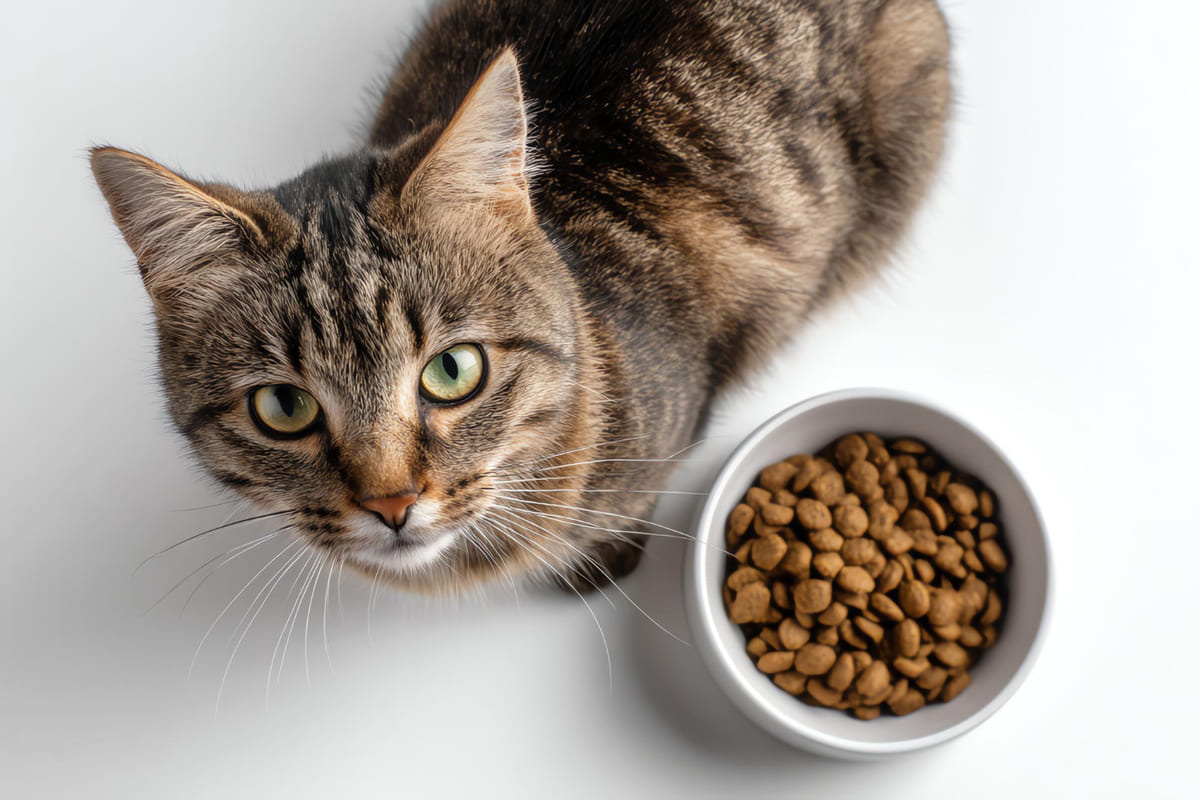
Fiber can help with weight management by diluting the calorie density of food. When fiber is added to food, the same volume portion contains fewer calories; the cat experiences fullness while receiving less energy.
It is necessary to add a parenthesis here. While it is often claimed that fiber increases the feeling of satiety, the results are not consistent in all cats. In other words, fiber in cat nutrition is not the sole determining lever in weight control. It should be considered as part of a balanced formula. In an overweight cat, the feeding plan should be designed in conjunction with calorie restriction and veterinary monitoring.
Important: Cat metabolism is dependent on high-quality animal protein. If protein quality is overlooked while increasing fiber and decreasing calories, the cat may begin to lose lean muscle mass instead of fat. In a proper weight-loss food, maintaining protein while increasing fiber is at least as important as the amount of fiber.
How Much Fiber Should Be in Cat Food? How to Read a Cat Food Label?

The "crude cellulose" value on the food label may underestimate the actual fiber content of the food. As defined in the 2025 version of the European pet food industry's nutritional guideline FEDIAF, fiber is mostly measured as crude cellulose using the Weende method in routine analysis.
This method cannot fully capture soluble and easily fermentable fibers. As a result, the crude cellulose line in the guaranteed analysis may show the total fiber as half as low.
A more accurate measure is total dietary fiber. When comparing foods, the healthiest approach is to evaluate fiber in grams per 100 kilocalories. Ultimately, the key is ensuring that the amount of fiber in cat food, presented in a well-balanced formula, is tailored to the cat's individual needs.
In growing kittens and older cats whose digestive efficiency is already reduced, unnecessarily high fiber can lead to a decline in muscle mass and coat quality.
That's why the amount of fiber in cat nutrition should be based on a balanced and complete formulation. The safest way for a healthy cat is to choose from cat foods that are transparent, complete, and balanced, with guaranteed analysis.
Important: High fiber is effective only when combined with adequate water intake. Fiber works by retaining water in the intestines. In a cat that doesn't drink enough water, high fiber, especially when combined with dry food, can draw away existing water in the intestines, hardening the stool and worsening constipation. If you are increasing your cat's fiber intake, be sure to discuss with your veterinarian how to increase its water consumption as well.
Frequently Asked Questions

Can cats live without fiber?
Technically, fiber is not an essential nutrient for cats and provides only a very small portion of their energy. However, it is included in balanced foods due to its functional contribution to digestive regularity, stool quality, and intestinal flora.
Should I give my cat extra fiber?
A cat fed a healthy, balanced commercial food often does not need extra fiber. If you are considering supplementation for hairballs or digestive complaints, the type and amount should be determined with a veterinarian. The wrong choice can create problems instead of benefits.
Is high-fiber food healthier for every cat?
No. While high fiber can be beneficial for weight control or certain bowel issues, too high fiber can reduce mineral absorption and dilute calories. The correct ratio varies depending on the cat's individual needs.
Does fiber really work for hairballs?
Studies show that certain fiber sources, particularly psyllium, can increase the excretion of hairballs in the stool. However, the effect varies depending on the type of fiber and the cat's coat type. As mentioned earlier, fiber alone should not be considered a definitive solution.
Does the "crude fiber" value on the food label indicate the amount of fiber?
Partially. Crude fiber only measures a fraction of the fiber and may underestimate the total fiber content. For a more accurate comparison, total dietary fiber and values per 100 kilocalories should be preferred.
Why is water consumption so important in high-fiber food?
Fiber functions by retaining water. If water intake is insufficient, especially in dry food with high fiber content, it can lead to constipation, contrary to expectations. Supporting water consumption in a cat with increased fiber intake is as crucial as the fiber itself.
References
Moreno AA, Parker VJ, Winston JA, Rudinsky AJ. Dietary fiber aids in the management of canine and feline gastrointestinal disease. Journal of the American Veterinary Medical Association (JAVMA), 2022. https://doi.org/10.2460/javma.22.08.0351
Kayser E, Finet SE, de Godoy MRC. The role of carbohydrates in canine and feline nutrition. University of Illinois at Urbana-Champaign.
FEDIAF (The European Pet Food Industry). Nutritional Guidelines for Complete and Complementary Pet Food for Cats and Dogs, 2025. https://europeanpetfood.org/self-regulation/nutritional-guidelines/
Dietary fibre and the importance of the gut microbiota in feline nutrition: a review. Nutrition Research Reviews, Cambridge University Press.
Advertisement
Advertisement
Keep exploring
Continue reading

Cat Nutrition
The Importance of Wet Food Consumption in Cats During Summer
When temperatures rise, cats, just like us, may have difficulty maintaining their fluid balance.
Read guide →
Cat Nutrition
Mineral Balance in Dry Cat Foods: The Role of Calcium and Phosphorus
The suitability of cat food for a cat in the long term is not determined solely by protein, fat, or calories.
Read guide →
Cat Nutrition
Essential Cat Food Ingredient Terms for Cat Owners
If you are a cat parent with at least one cat eagerly awaiting your return and nourished by your love in addition to the food you provide, this…
Read guide →
Cat Nutrition
What Should You Read on the Ingredient Label When Choosing Dry Cat Food?
Every cat parent wants to make sure they are getting the right dry food for their cat. At this point, you might be thinking, "Okay, but how can I be…
Read guide →